From the very outset, advertising has been crafted in such a way that it persuades the audience through associating different goods with certain values, feelings, and lifestyle. Throughout the decades, it has not only reflected but molded people’s perception about health, trustworthiness, and desirable attributes. As compared to past advertisements that would make audacious statements without any restraint, contemporary advertising takes into account regulatory frameworks and public consciousness. An example of this evolution in advertising can be given by comparing an advertisement for the brand of cigarettes “Camel” made in the 1940s with that of an anti-tobacco advertising campaign of the Centers for Disease Control and Prevention (CDC).

“More Doctors Smoke Camels” cigarette advertisement promoting Camel cigarettes using medical endorsement.
One of the most noticeable features of the ad being discussed is its appeal to the statement "More Doctors Smoke Camels Than Any Other Cigarette." It tries to convey the idea that Camel cigarettes have the full confidence of doctors. The picture of the neatly dressed doctor with the cigarette adds extra credibility to the message, as people had high regard for these specialists at that time.
Overall, the ad has a rather calm, assured and reassuring tone. The ad tries to persuade the viewer that it is perfectly fine to smoke Camel cigarettes because the product has already been recommended by many others before. With that in mind, the pictures of multiple individuals at the bottom part of the ad add up to this impression. They show that smoking is widely accepted among different social groups.
The implied audience seems to consist of adults who consider themselves as health-conscious, high status, and accepted members of society. The link established between cigarettes and doctors and regular citizens implies that smoking is not only safe but also a part of societal norms. This mirrors the societal values of the time when little was known about the dangers associated with smoking and good health meant looking well and feeling reassured.
In general, the above-mentioned commercial is proof of the way companies could market harmful products using the power of authority and trust.
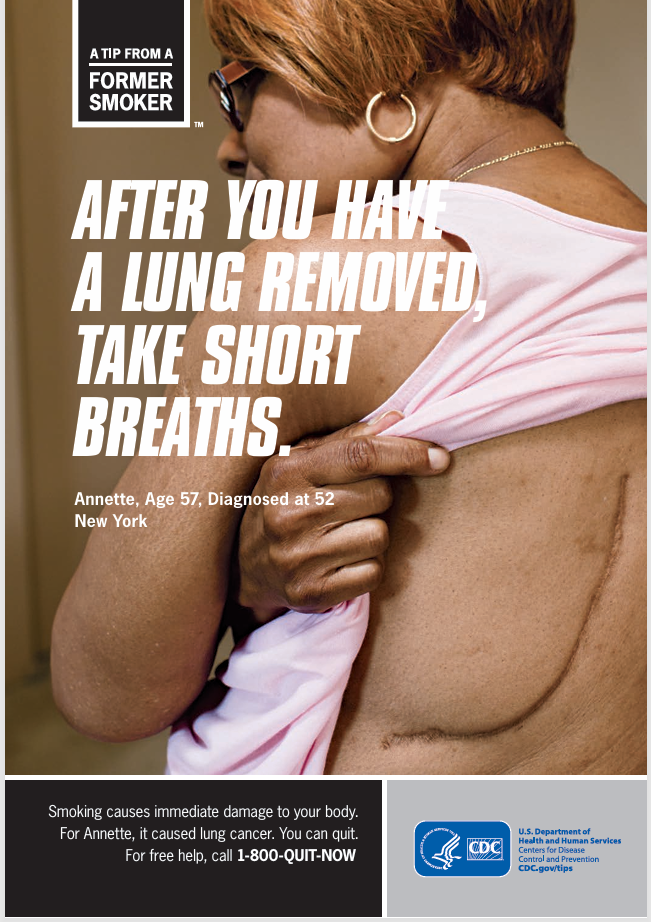
“A Tip From a Former Smoker: Annette” anti-smoking advertisement showing the physical effects of smoking
However, the contemporary advertisement published by the CDC is quite another case. First, while the earlier advertisement encourages people to smoke, the latter tries to draw attention to the risks and health problems associated with this harmful habit. In this advertisement, a particular person called Annette is shown. According to the story, she smoked for many years before she had to have her lung removed due to the development of cancer.
The feature that makes this advertisement particularly powerful is its emotional appeal. While the advertisement about Camels assures the audience, this one shocks it with its realistic and graphic information about the effects of smoking. As can be seen, this advertisement relies on fear appeal.
The target audience is broad, including both smokers and non-smokers. The goal is not to sell a product but to change behavior and encourage people to quit smoking. This reflects a major shift in the purpose of advertising—from promoting consumption to protecting public health. The CDC’s “Tips From Former Smokers” campaign specifically uses real stories to show how smoking affects everyday people, making the message more credible and impactful.
This ad reflects modern values that prioritize health, transparency, and accountability. Society now has a much better understanding of the risks of smoking, and advertising is more regulated to prevent misleading claims. The definition of what is considered “good” has also changed, shifting from appearance and social acceptance to long-term health and well-being.
In evaluating the two ads, it is clear that the disparity lies not only in the evolution of the art of advertisement but also the development of value systems within society. While the first advertisement for Camel uses authority, assurance, and social proof to sell smoking, the second one by the CDC uses emotions, reality, and personal experience to deter people from smoking.
The greatest disparity is how credibility is used in these two ads. For instance, while the Camel ad uses authority to create credibility in the form of doctors, the CDC ad uses reality and medical consequences to make its claims credible. Rather than assure people that smoking does not have serious effects, it gives the exact opposite message.
Desirability too carries an entirely new meaning now when compared to the earlier perception of smoking being a sophisticated habit that helped relax people and was good for their health. It shows how there have been many changes in the society as far as medical knowledge and advertisements are concerned.
Technology and the use of the media have also contributed to these changes in perceptions about smoking. Nowadays, the use of technology means that advertising can be done in ways that allow the use of true pictures and real stories about the lives of ordinary people in order to reach more people.
In summary, these two ads provide evidence of changes that occurred not only in the field of advertising but also within society. While the advertisement for Camel cigarettes demonstrates the era where the company was capable of marketing unhealthy products through persuasive and authoritative advertising, the advertisement from the CDC demonstrates an era that prioritizes scientific information, truth, and educating the audience.
Overall, the analysis demonstrates that there are several ways in which advertising reflects social changes. One of those is the need to become more transparent about marketing techniques and products advertised. Advertising still plays a vital role in today’s society, as it is a tool that allows people to spread their ideas and communicate their needs.
Create Your Own Website With Webador